
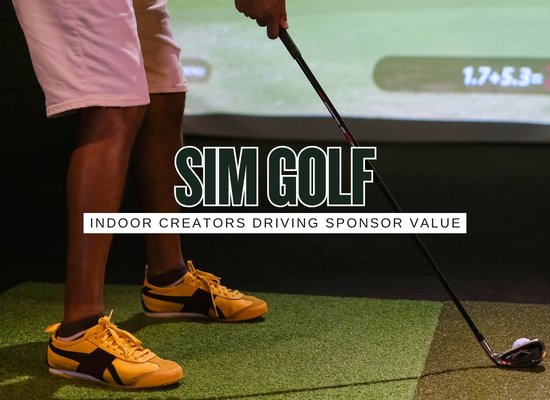
Indoor golf used to feel like a backup plan for bad weather. Now it is becoming its own media category, buyer research channel, content studio, training space, league format, and sponsor lane. The timing is strong: NGF says simulator and screen-golf participation has more than doubled since 2019, and its 2025 simulator overview calls indoor simulators one of the fastest-growing segments of U.S. golf engagement. Market researchers also project continued simulator growth, with Fortune Business Insights estimating the global golf simulator market at $1.92 billion in 2025 and $2.11 billion in 2026, reaching $4.7 billion by 2034. TGL has pushed tech-driven indoor golf into prime-time sports, while Golf Monthly’s new Performance Lab shows how simulator-based testing is becoming part of serious equipment journalism.
Golf simulator creators sit closer to the buying decision than most golf influencers
A golfer watching a simulator channel is often not just passing time. They may be pricing launch monitors, comparing hitting mats, planning a garage build, choosing software, checking ceiling height, evaluating ball data, or deciding whether a $3,000 to $30,000 setup is worth it. That makes simulator influencers unusually valuable for sponsors because the audience is already thinking like a buyer.
The sponsor appeal behind simulator content
Golf simulator content has a different commercial shape than normal golf entertainment. A funny course vlog can create broad awareness, but a simulator review can sit directly inside a buyer’s research process. The viewer may be comparing Garmin, Bushnell, Foresight, Uneekor, FlightScope, TrackMan, SkyTrak, Rapsodo, Full Swing, hitting mats, impact screens, projectors, enclosures, turf, side nets, gaming PCs, software licenses, and room layouts.
That creates a sponsorship environment where detail is an advantage. A creator can show unboxing, setup difficulty, misreads, left-handed and right-handed switching, club data, ball speed, spin axis, room-depth requirements, projector brightness, screen bounceback, software lag, and real indoor gameplay. Those details may sound too technical for a casual reel, but they are exactly the details that reduce purchase anxiety.
Dream stage
The viewer is imagining a garage, basement, spare room, club bay, restaurant simulator, or 24-hour indoor golf concept. The content that wins here is visual: room tours, budget builds, before-and-after transformations, and “mistakes I made” videos.
Research stage
The buyer begins comparing launch monitors, software, mats, screens, projectors, nets, PCs, side barriers, lighting, and subscription costs. Influencers with testing discipline become more valuable than broad-reach lifestyle creators.
Confidence stage
The viewer wants proof that the system works in a real room. This is where sponsor integrations should show setup, data quality, gameplay, support, space requirements, and practical tradeoffs.
Expansion stage
After purchase, the owner may buy better turf, software add-ons, cameras, putting upgrades, acoustic panels, lighting, a PC, lessons, online leagues, or club-fitting services. That gives sponsors repeat exposure opportunities.
Influencer types that matter in the simulator niche
The best simulator campaigns usually match one of these creator lanes. A launch monitor sponsor should not use the same influencer strategy as a golf bar, home-install company, training aid brand, or simulator software platform.
① Buyer-research reviewers
These channels compare launch monitors, simulator software, mats, projectors, PCs, enclosures, and accessories. Their audience is high-intent because viewers are actively researching a purchase.
② Garage-build creators
These creators show the messy reality of building an indoor golf space: ceiling height, flooring, lighting, bounceback, screen size, lefty-righty play, spouse approval, budget creep, and renovation mistakes.
③ Data-backed instruction creators
These creators use launch-monitor numbers to teach. The sponsor value comes from connecting equipment to improvement: attack angle, spin, face-to-path, carry distance, wedge control, driver fitting, and club gapping.
④ Simulator entertainment channels
These creators turn indoor golf into matches, leagues, trick-shot contests, winter golf nights, family competitions, and online simulator tournaments. They are useful when the sponsor wants participation, not just product research.
⑤ Retail and media-lab influencers
Retailers and golf media brands can function like influencers when they produce trusted comparison content. Their commercial role is different, but their impact on buyer confidence can be significant.
Channels and media nodes sponsors should study
This list is not a strict popularity ranking. It is a sponsor research map showing different kinds of simulator influence. Some are independent creator channels, some are retailer or media channels, and some blend simulator testing with broader golf content.
| Channel or media node | Influence lane | Audience likely to attract | Strong sponsor fit | Public profiles |
|---|---|---|---|---|
| Golf Simulator Videos | Dedicated simulator technology and launch-monitor testing | Buyers comparing launch monitors, software, screens, PCs, and full builds | Launch monitors, simulator software, hitting mats, gaming PCs, projectors, enclosure systems | YouTube |
| Garage Golf | Hands-on garage golf reviews and practical advice | Home simulator builders, regular golfers, budget-conscious buyers | DIY simulator packages, hitting mats, launch monitors, screens, nets, accessories | YouTube | Website |
| Let’s Play Thru | Golf gear reviews, launch-monitor testing, travel, and entertainment | Golfers who want gear guidance with a more lifestyle-friendly tone | Portable launch monitors, golf travel, accessories, golf tech, affiliate campaigns | YouTube | Instagram |
| MrShortGame Golf | Broad golf creator with simulator-build and gear content | Everyday golfers who enjoy approachable equipment, home golf, and game-improvement content | Home simulator builds, training aids, mats, nets, launch monitors, improvement products | YouTube | Instagram |
| Golf Monthly Reviews | Data-backed equipment testing through a simulator-powered performance lab | Golfers comparing clubs, balls, shafts, and measurable performance claims | Club brands, ball brands, launch monitors, fitting tools, performance products | YouTube | Website |
| The Indoor Golf Shop | Retail education for full simulator builds | Buyers ready to compare packages, enclosures, mats, projectors, and custom installs | Full simulator packages, financing offers, installation, projectors, screens, turf, accessories | Website | Instagram |
| Rain or Shine Golf | Retail and education around home simulator packages | Homeowners and golfers looking for simplified simulator buying paths | Build kits, simulator bundles, hitting bays, mats, launch monitors, room planning | Website | YouTube |
| TrackMan Golf | Brand-owned technology education and simulator storytelling | Coaches, fitters, facilities, serious players, indoor golf operators | Partnership reference point for facilities, training, club fitting, and data-driven content | YouTube | Instagram |
| TGL and Full Swing ecosystem | Prime-time tech-golf entertainment and simulator legitimacy | Fans interested in indoor golf as a watchable sports product, not only a practice tool | Tech-golf event sponsorship, simulator venues, league nights, data graphics, entertainment concepts | TGL | Full Swing |
Products that fit simulator creators especially well
Simulator influence is strongest when the audience has a problem that can be demonstrated on camera. Sponsors should look for products that improve the build, simplify setup, improve data confidence, protect the room, make practice better, or create more fun inside the bay.
| Sponsor category | Buyer question | Creator proof that works | Best content format |
|---|---|---|---|
| Launch monitors | Will the data be accurate in my space? | Side-by-side testing, misread checks, indoor and outdoor comparison, club data review | Deep review, comparison video, setup guide, buyer Q&A |
| Hitting mats and turf | Will it feel real and protect my joints? | Divot feel, bounce, fatigue, durability, stance stability, hitting insert replacement | Long-term test, budget comparison, injury-prevention angle |
| Impact screens and enclosures | Will it be safe, quiet, and clear? | Bounceback test, sound test, projector clarity, side-net coverage, wedge impact test | Room-build video, safety checklist, installation review |
| Projectors and gaming PCs | Will the software run smoothly and look good? | Frame rate, brightness, resolution, delay, compatibility, cable management | Technical build guide, upgrade video, software performance test |
| Simulator software | Will it keep me playing after the novelty fades? | Course library, online play, leagues, practice modes, graphics, shot response | Gameplay series, winter league, software comparison |
| Golf lessons and coaching | Can simulator data actually help me improve? | Before-and-after numbers, wedge gapping, driver fit, face-to-path, dispersion changes | Lesson series, data breakdown, monthly progress content |
| Indoor golf venues | Is this place worth booking regularly? | Bay quality, food and drink, league atmosphere, booking process, tech reliability | Venue tour, league-night recap, creator match, local guide |
Campaign concepts that feel native to indoor golf
The strongest simulator campaigns do not interrupt the content. They become the content. A sponsor should create a reason for the product to appear, be tested, and be discussed.
A The $5,000 build challenge
A creator builds the most playable simulator possible under a fixed budget. Sponsors can own the mat, net, launch monitor, projector, lighting, or software slot.
B Launch monitor truth week
A week of side-by-side tests across carry distance, spin, wedge shots, driver speed, chips, left-handed play, and setup difficulty.
C Winter league creator series
A simulator venue, software platform, or local sponsor backs a creator-led indoor league with weekly standings, highlight clips, and fan challenges.
D Garage to green-grass test
A creator trains indoors for 30 days, then takes the same wedge, driver, or scoring goal outside to see whether the simulator work transfers.
E Room mistake audit
The creator reviews ceiling height, ball flight, screen distance, lighting, projector placement, sound, side protection, turf wear, and hidden costs.
F Family simulator night
A creator shows how indoor golf works for kids, spouses, beginners, mixed skill groups, and rainy weekends. This is useful for venues and home-build sellers.
Sponsorship fit calculator
Simulator creator campaign score
Use this simple calculator to estimate whether a simulator creator campaign is better suited for a full sponsorship, affiliate test, product-seeding package, or smaller paid post.
Scoring logic: each input receives a 1 to 5 value. The total becomes a 100-point score. High scores favor full sponsorship or multi-video integration. Middle scores favor affiliate tests or product seeding. Lower scores suggest a smaller paid test or a different creator type.
Metrics sponsors should track
Simulator campaigns should be judged differently from lifestyle golf campaigns. The audience may watch slowly, return later, compare multiple videos, and buy after a long research window. That means the strongest signals are not always immediate likes.
| Metric | Good signal | Weak signal | Sponsor action |
|---|---|---|---|
| Comment quality | Questions about price, room size, compatibility, accuracy, setup, and alternatives | Generic praise with no buyer detail | Reply with helpful answers and link to a buyer guide |
| Search-driven views | Video continues gaining views months after publishing | One-day spike with no long-tail traffic | Favor evergreen review topics and comparison titles |
| Affiliate activity | Clicks across several days or weeks, not just launch day | High views with low landing-page interest | Improve offer, landing page, or product match |
| Viewer retention | Strong watch time through setup, testing, and verdict sections | Drop-off before product proof | Move proof earlier and reduce generic intro content |
| Saved or shared content | Viewers save build guides, checklists, and comparison videos | Low saves on high-cost products | Add downloadable checklists or room-planning tools |
Buyer-focused sponsor checklist
- Give the creator real testing time: Simulator buyers notice rushed reviews.
- Show the room setup: Space requirements can be as important as product features.
- Compare against alternatives: Buyers rarely evaluate a simulator product in isolation.
- Include the hidden costs: Software, subscriptions, turf, projector, PC, lighting, and installation can shape the final decision.
- Track beyond launch week: Simulator videos often work like evergreen buying guides.
Practical takeaways for sponsors
1 Treat simulator creators like product educators
The best creators in this niche do more than promote. They reduce buyer confusion. Give them enough detail, time, and access to explain the product honestly.
2 Build campaigns around real decisions
The strongest topics are not vague. They answer questions like “Will this fit in my garage?” “Is this accurate indoors?” “Can my kids use it?” and “Is the upgrade worth it?”
3 Use multiple creator lanes
A strong launch can include a technical reviewer, a garage-build creator, a golf instructor using data, and a venue or league account showing social use.
4 Respect the long purchase window
Simulator buyers may take weeks or months to decide. Evergreen reviews, comparison guides, setup videos, and follow-up content can outperform one-off short clips.